BiTraP: Bi-directional Pedestrian Trajectory Prediction with Multi-modal Goal Estimation
Yu Yao · Ella Atkins · Matthew Johnson-Roberson · Ram Vasudevan · Xiaoxiao Du
TL;DR
BiTraP predicts pedestrian paths by estimating a goal and decoding bi-directionally, reducing long-horizon error by about 10\u201350% over prior methods.
BRIEF
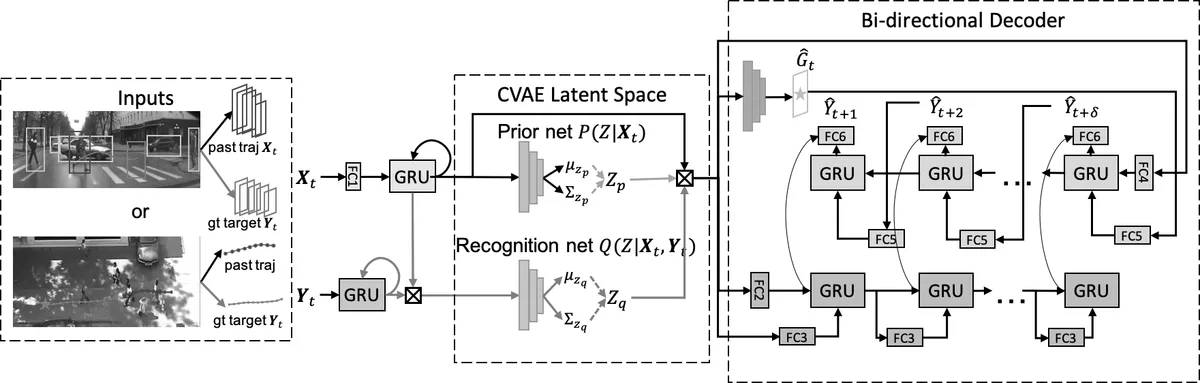
Robots that drive or navigate around people need to anticipate where pedestrians will go. Common predictors use recurrent networks inside a conditional variational autoencoder, but their errors build up over horizons of two seconds or more. BiTraP first estimates where a pedestrian is headed, then decodes the path both forward from the past and backward from that goal. It works on first-person and bird's-eye views and improves on prior results by roughly 10\u201350%. The authors also show that the choice of target model shapes the predicted distribution.
Abstract
Pedestrian trajectory prediction is an essential task in robotic applications such as autonomous driving and robot navigation. State-of-the-art trajectory predictors use a conditional variational autoencoder (CVAE) with recurrent neural networks (RNNs) to encode observed trajectories and decode multi-modal future trajectories. This process can suffer from accumulated errors over long prediction horizons (<inline-formula><tex-math notation="LaTeX">$\geq\! 2$</tex-math></inline-formula> seconds). This letter presents <italic>BiTraP</italic>, a goal-conditioned bi-directional multi-modal trajectory prediction method based on the CVAE. BiTraP estimates the goal (end-point) of trajectories and introduces a novel bi-directional decoder to improve longer-term trajectory prediction accuracy. Extensive experiments show that BiTraP generalizes to both first-person view (FPV) and bird's-eye view (BEV) scenarios and outperforms state-of-the-art results by <inline-formula><tex-math notation="LaTeX">$\sim\! 10\text{–}50\%$</tex-math></inline-formula>. We also show that different choices of non-parametric versus parametric target models in the CVAE directly influence the predicted multi-modal trajectory distributions. These results provide guidance on trajectory predictor design for robotic applications such as collision avoidance and navigation systems. <italic>Our code is available at: <uri>https://github.com/umautobots/bidireaction-trajectory-prediction</uri>.</italic>