DarkGS: Learning Neural Illumination and 3D Gaussians Relighting for Robotic Exploration in the Dark
Tianyi Zhang · Kaining Huang · Weiming Zhi · Matthew Johnson-Roberson
TL;DR
A learned model of a robot's moving onboard light lets 3D Gaussian scenes be reconstructed, relit and rendered in real time in the dark.
BRIEF
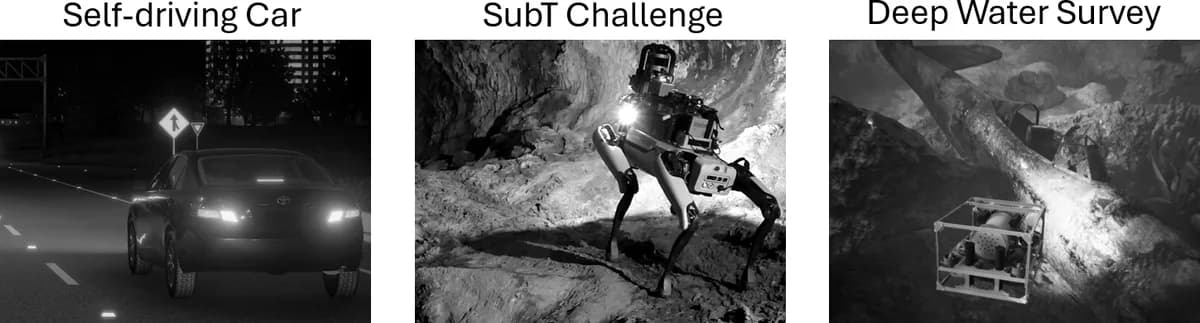
Robots working in dark places, such as tunnels or caves, often carry their own light, so the lighting changes with every movement. That breaks standard 3D reconstruction methods, which assume fixed illumination. This work treats the camera-light pair as something to learn: a neural light simulator is calibrated from images of a target with known markers. The learned light model is then used to build a 3D Gaussian scene that can be rendered in real time from new viewpoints and relit. Experiments span several real-world environments.
Abstract
Humans have the remarkable ability to construct consistent mental models of an environment, even under limited or varying levels of illumination. We wish to endow robots with this same capability. In this paper, we tackle the challenge of constructing a photorealistic scene representation under poorly illuminated conditions and with a moving light source. We approach the task of modeling illumination as a learning problem, and utilize the developed illumination model to aid in scene reconstruction. We introduce an innovative framework that uses a data-driven approach, Neural Light Simulators (NeLiS), to model and calibrate the camera-light system. Furthermore, we present DarkGS, a method that applies NeLiS to create a relightable 3D Gaussian scene model capable of real-time, photorealistic rendering from novel viewpoints. We show the applicability and robustness of our proposed simulator and system in a variety of real-world environments. Code released at https://tyz1030.github.io/proj/darkgs.html