DOSE3 : Diffusion-based Out-of-distribution detection on SE(3) trajectories
Hongzhe Cheng · Tianyou Zheng · Ziyong Ma · Tianyi Zhang · Matthew Johnson-Roberson · Weiming Zhi
TL;DR
DOSE3 detects out-of-distribution robot and vehicle pose trajectories using a diffusion model over SE(3), without retraining when the inlier set changes.
BRIEF
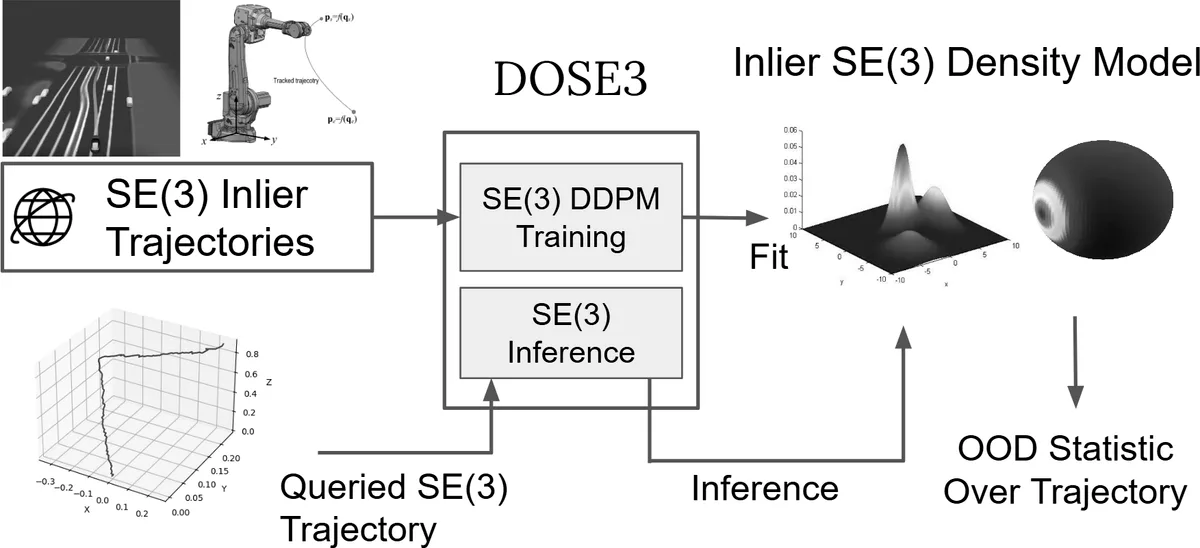
Robots often need to know when the motion data they see is unlike anything they were trained on. Most out-of-distribution detectors must be retrained whenever the notion of normal changes, and unified diffusion-based detectors have mostly worked in Euclidean or latent spaces. DOSE3 applies a diffusion model directly to sequences of 6-DoF poses in SE(3), keeping rotations on the SO(3) manifold. It builds an outlier score from the model's noise estimator. Tests on real vehicle and robot manipulator trajectory datasets show strong detection performance.
Abstract
Out-of-Distribution (OOD) detection, the task of identifying when an input falls outside the distribution seen at training time, is critical for deploying safe and reliable systems.Traditional OOD methods require retraining models whenever the in-distribution has changed.Recent work introduces <italic>unified</italic> models for OOD detection, where metrics can be constructed from an unconditional diffusion model trained on an arbitrary dataset, and the inlier distribution can be changed without retraining the diffusion model. However, these unified approaches have been largely confined to Euclidean or latent space domains. In contrast, real-world robotics systems often perceive and act through sequences of 6 degrees-of-freedom poses in the Special Euclidean Group <inline-formula><tex-math notation="LaTeX">$\mathbb{SE}(3)$</tex-math></inline-formula>, taking into account both translations and orientation changes over time. In this work, we extend Out-of-Distribution (OOD) detection to trajectories in <italic>Special Euclidean Group in 3D</italic> (<inline-formula><tex-math notation="LaTeX">$\mathbb{SE}(3)$</tex-math></inline-formula>) by presenting a <bold>D</bold><italic>iffusion-based</italic> <bold>O</bold><italic>ut-of-distribution detection on <inline-formula><tex-math notation="LaTeX">$\mathbb{SE}(3)$</tex-math></inline-formula></italic> (<inline-formula><tex-math notation="LaTeX">$\mathbf {DOSE3}$</tex-math></inline-formula>). <inline-formula><tex-math notation="LaTeX">$\mathbf {DOSE3}$</tex-math></inline-formula> constructs an OOD metric from the noise estimator model of a diffusion model over <inline-formula><tex-math notation="LaTeX">$\mathbb{SE}(3)$</tex-math></inline-formula> to separate outlier samples from inlier distributions. We demonstrate <inline-formula><tex-math notation="LaTeX">$\mathbf {DOSE3}$</tex-math></inline-formula>’s strong performance on OOD detection frameworks through extensive validation on multiple real-world robotics and autonomous systems datasets, covering vehicle and robot manipulator motion trajectories.