A Kinematic Model for Trajectory Prediction in General Highway Scenarios
Cyrus Anderson · Ram Vasudevan · Matthew Johnson-Roberson
TL;DR
A kinematic model of car-following and lane changes predicts highway trajectories in general scenarios, staying interpretable while outperforming state-of-the-art methods on highway datasets.
BRIEF
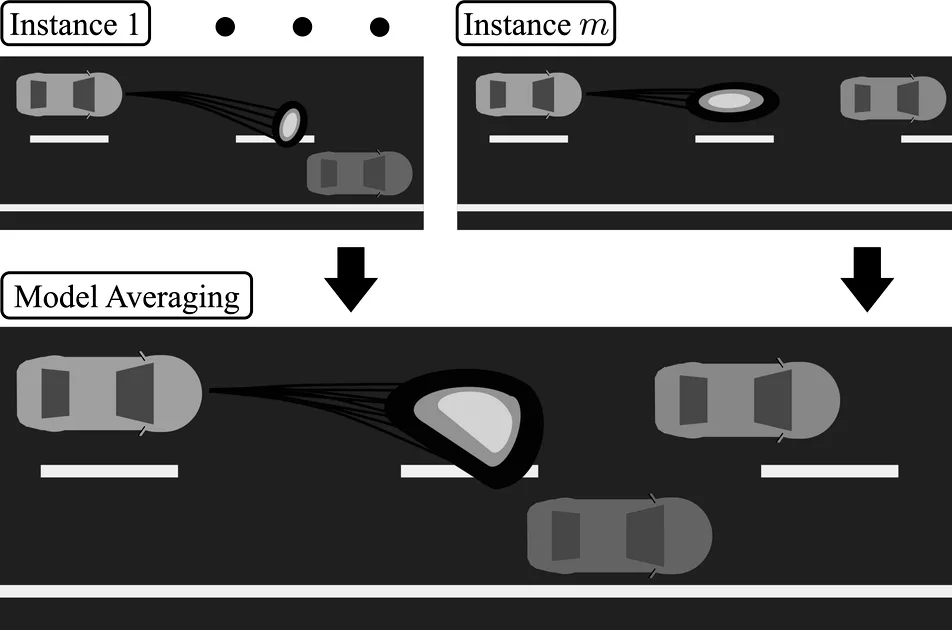
Autonomous vehicles on highways need to anticipate what nearby drivers will do, since speeds are high and interactions are close. Traditional kinematic predictors are interpretable but often ignore other drivers or cover only a few scenarios, while data-driven models are accurate but hard to validate. This work introduces a kinematic model describing car-following and lane-change behavior, then combines instances of it to predict trajectories in general highway scenarios. Tests on highway datasets under varied sensing conditions show it outperforming state-of-the-art methods.
Abstract
Highway driving invariably combines high speeds with the need to interact closely with other drivers. Prediction methods enable autonomous vehicles (AVs) to anticipate drivers' future trajectories and plan accordingly. Kinematic methods for prediction have traditionally ignored the presence of other drivers, or made predictions only for a limited set of scenarios. Data-driven approaches fill this gap by learning from large datasets to predict trajectories in general scenarios. While they achieve high accuracy, they also lose the interpretability and tools for model validation enjoyed by kinematic methods. This letter proposes a novel kinematic model to describe car-following and lane change behavior, and extends it to predict trajectories in general scenarios. Experiments on highway datasets under varied sensing conditions demonstrate that the proposed method outperforms state-of-the-art methods.