Leveraging the Template and Anchor Framework for Safe, Online Robotic Gait Design
Jinsun Liu · Pengcheng Zhao · Zhenyu Gan · Matthew Johnson-Roberson · Ram Vasudevan
TL;DR
Reachability analysis on a simple template model, with error bounds to the full model, lets online model predictive control choose bipedal gaits that stay safe.
BRIEF
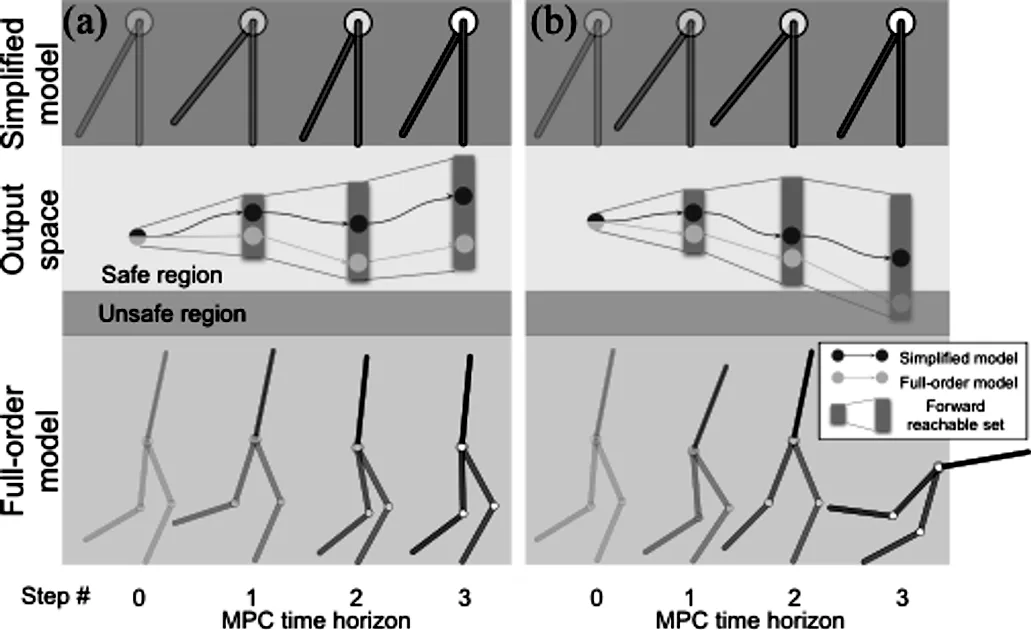
Planning a walking gait for a bipedal robot in real time is hard because the full dynamic model has many states. A common shortcut is to plan with a simpler template model, but that gives no formal assurance that the real, full-order robot (the anchor) stays upright. This work computes reachable sets on the template and expands them using functions that bound the difference between the two models. The result is used within Model Predictive Control to choose gaits online. On a 5-link RABBIT model, the robot walked safely.
Abstract
Online control design using a high-fidelity, full-order model for a bipedal robot can be challenging due to the size of the state space of the model. A commonly adopted solution to overcome this challenge is to approximate the fullorder model (anchor) with a simplified, reduced-order model (template), while performing control synthesis. Unfortunately it is challenging to make formal guarantees about the safety of an anchor model using a controller designed in an online fashion using a template model. To address this problem, this paper proposes a method to generate safety-preserving controllers for anchor models by performing reachability analysis on template models by relying on functions that bound the difference between the two models. This paper describes how this reachable set can be incorporated into a Model Predictive Control framework to select controllers that result in safe walking on the anchor model in an online fashion. The method is illustrated on a 5-link RABBIT model, and is shown to allow the robot to walk safely while utilizing controllers designed in an online fashion.