LiStereo: Generate Dense Depth Maps from LIDAR and Stereo Imagery
Junming Zhang · Manikandasriram Srinivasan Ramanagopal · Ram Vasudevan · Matthew Johnson-Roberson
TL;DR
LiStereo fuses sparse LIDAR with stereo images to produce dense depth maps, trained without ground-truth labels and robust to low-resolution LIDAR.
BRIEF
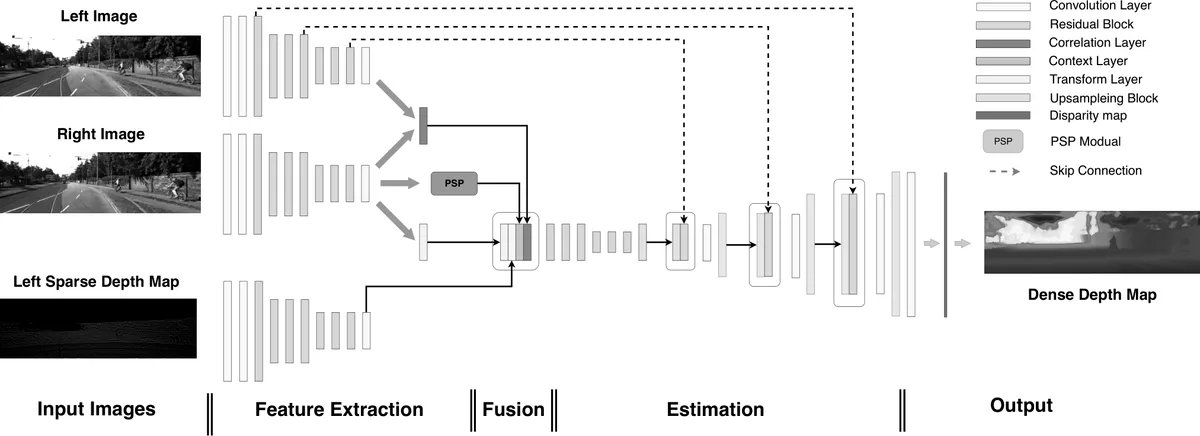
Autonomous vehicles need accurate depth maps, but high-resolution LIDAR is expensive and sparse at long range, while stereo matching gives denser depth that is less accurate far away. LiStereo combines the two, taking a stereo image pair and a sparse LIDAR depth map and producing a dense depth map. It trains in a self-supervised way, without ground-truth depth labels. Experiments show high-quality dense depth, even with low-resolution LIDAR input, suggesting cheaper LIDARs could be paired with stereo cameras.
Abstract
An accurate depth map of the environment is critical to the safe operation of autonomous robots and vehicles. Currently, either light detection and ranging (LIDAR) or stereo matching algorithms are used to acquire such depth information. However, a high-resolution LIDAR is expensive and produces sparse depth map at large range; stereo matching algorithms are able to generate denser depth maps but are typically less accurate than LIDAR at long range. This paper combines these approaches together to generate high-quality dense depth maps. Unlike previous approaches that are trained using ground-truth labels, the proposed model adopts a self-supervised training process. Experiments show that the proposed method is able to generate high-quality dense depth maps and performs robustly even with low-resolution inputs. This shows the potential to reduce the cost by using LIDARs with lower resolution in concert with stereo systems while maintaining high resolution.