Low cost underwater acoustic localization
Eduardo Iscar · Atulya Shree · Nicholas Goumas · Matthew Johnson-Roberson
TL;DR
A low-cost one-way travel-time acoustic ranging system using surface buoys could localize deep-sea micro AUVs, cutting simulated error by a factor of three.
BRIEF
Deep-water robots are expensive in part because tracking their position underwater with sound is hard. Cheaper marine platforms have mostly stayed at the surface or in shallow water. A low-cost one-way travel-time ranging system is proposed: surface buoys that know their own positions, and underwater nodes that measure range from the timing of acoustic signals. The work compares localization methods and describes the transducer and electronics, so the system can fit into a deep-sea micro AUV under development. Simulations show error reductions by a factor of three.
Abstract
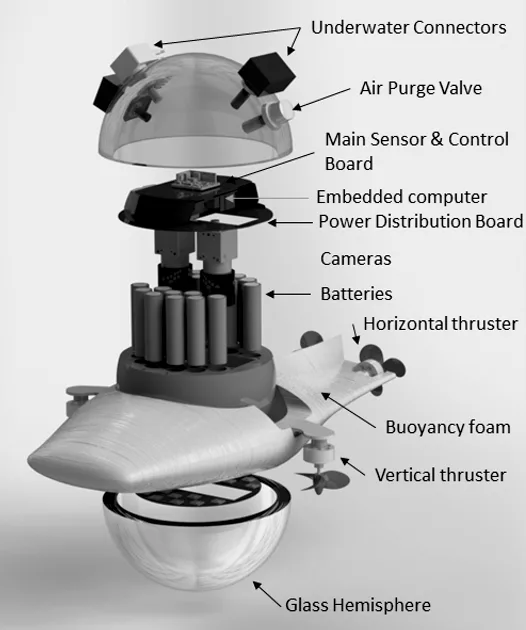
Over the course of the last decade, the cost of marine robotic platforms has significantly decreased. In part this has lowered the barriers to entry of exploring and monitoring larger areas of the earth's oceans. However, these advances have been mostly focused on autonomous surface vehicles (ASVs) or shallow water autonomous underwater vehicles (AUVs). One of the main drivers for high cost in the deep water domain is the challenge of localizing such vehicles using acoustics. A low cost one-way travel time underwater ranging system is proposed to assist in localizing deep water submersibles. The system consists of location aware anchor buoys at the surface and underwater nodes. This paper presents a comparison of methods together with details on the physical implementation to allow its integration into a deep sea micro AUV currently in development. Additional simulation results show error reductions by a factor of three.