Off The Beaten Sidewalk: Pedestrian Prediction In Shared Spaces For Autonomous Vehicles
Cyrus Anderson · Ram Vasudevan · Matthew Johnson-Roberson
TL;DR
A real-time, interpretable model learns when pedestrians yield to vehicles and how that changes their motion, predicting trajectories in shared spaces.
BRIEF
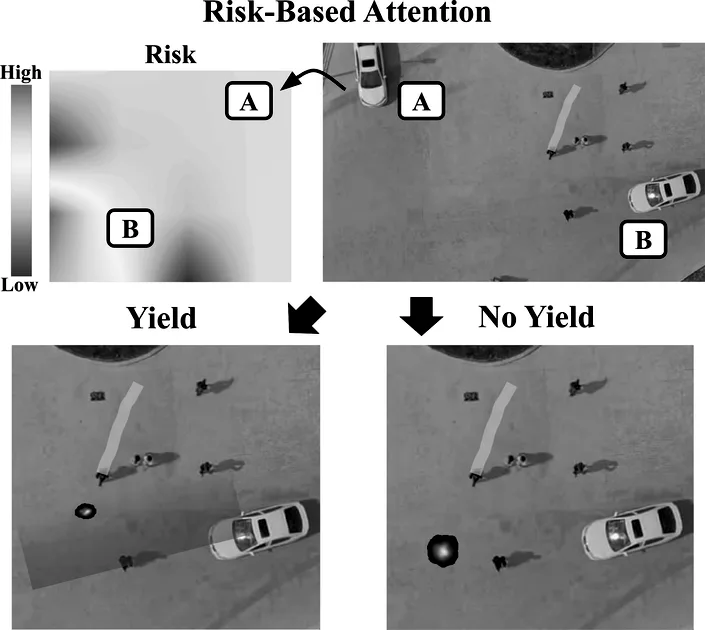
Self-driving cars must anticipate where pedestrians will walk, including in places without crosswalks, signals, or curbs. Model-based predictors need that structure, while deep networks generalize but are hard to interpret. This work combines the two: a risk-based attention mechanism learns when a pedestrian yields to a vehicle, and a learned vehicle influence describes how yielding changes their motion. The resulting probabilistic method, Off the Sidewalk Predictions, runs in real time and reports state-of-the-art accuracy on urban datasets, in shared spaces and traditional scenes.
Abstract
Pedestrians and drivers interact closely in a wide range of environments. Autonomous vehicles (AVs) correspondingly face the need to predict pedestrians' future trajectories in these same environments. Traditional model-based prediction methods have been limited to making predictions in highly structured scenes with signalized intersections, marked crosswalks, or curbs. Deep learning methods have instead leveraged datasets to learn predictive features that generalize across scenes, at the cost of model interpretability. This letter aims to achieve both widely applicable and interpretable predictions by proposing a risk-based attention mechanism to learn when pedestrians yield, and a model of vehicle influence to learn how yielding affects motion. A novel probabilistic method, Off the Sidewalk Predictions (OSP), uses these to achieve accurate predictions in both shared spaces and traditional scenes. Experiments on urban datasets demonstrate that the realtime method achieves state-of-the-art performance.