Stochastic Sampling Simulation for Pedestrian Trajectory Prediction
Cyrus Anderson · Xiaoxiao Du · Ram Vasudevan · Matthew Johnson-Roberson
TL;DR
A simulator seeded with a little real data generates synthetic pedestrian trajectories that train Social GAN to outperform training on real annotated data.
BRIEF
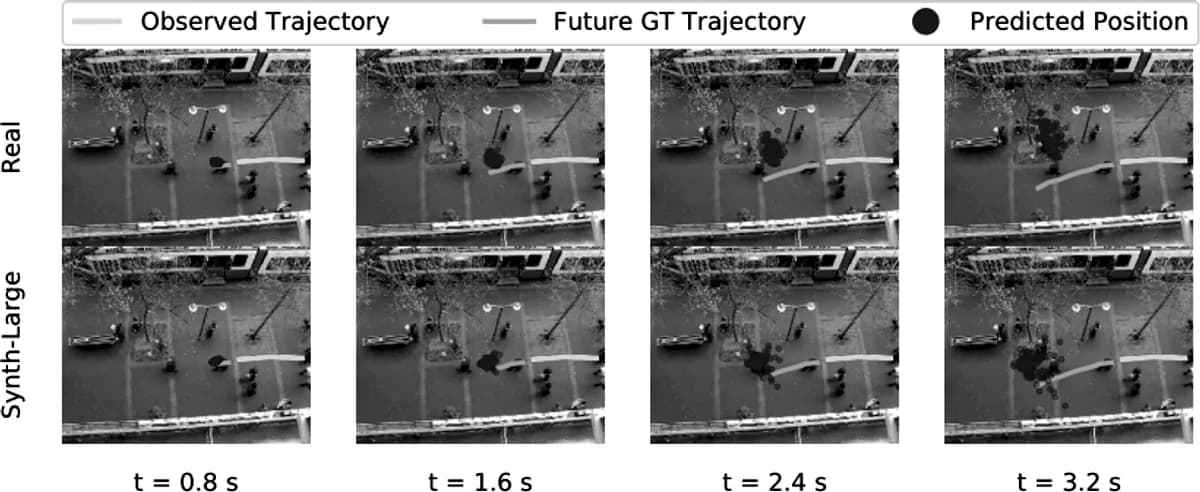
Self-driving cars need to predict where nearby pedestrians will walk, and the neural networks that do this usually depend on large, hand-annotated datasets of real walking behavior. Collecting those datasets takes substantial time and labor. This work builds a stochastic sampling-based simulator that uses a small amount of real annotation to generate many automatically labeled synthetic pedestrian trajectories. Social GAN, trained only on this synthetic data, predicted better than the same network trained on human-annotated real data.
Abstract
Urban environments pose a significant challenge for autonomous vehicles (AVs) as they must safely navigate while in close proximity to many pedestrians. It is crucial for the AV to correctly understand and predict the future trajectories of pedestrians to avoid collision and plan a safe path. Deep neural networks (DNNs) have shown promising results in accurately predicting pedestrian trajectories, relying on large amounts of annotated real-world data to learn pedestrian behavior. However, collecting and annotating these large real-world pedestrian datasets is costly in both time and labor. This paper describes a novel method using a stochastic sampling-based simulation to train DNNs for pedestrian trajectory prediction with social interaction. Our novel simulation method can generate vast amounts of automatically-annotated, realistic, and naturalistic synthetic pedestrian trajectories based on small amounts of real annotation. We then use such synthetic trajectories to train an off-the-shelf state-of-the-art deep learning approach Social GAN (Generative Adversarial Network) to perform pedestrian trajectory prediction. Our proposed architecture, trained only using synthetic trajectories, achieves better prediction results compared to those trained on human-annotated real-world data using the same network. Our work demonstrates the effectiveness and potential of using simulation as a substitution for human annotation efforts to train high-performing prediction algorithms such as the DNNs.