Occlusion-Aware Risk Assessment for Autonomous Driving in Urban Environments
Ming-Yuan Yu · Ram Vasudevan · Matthew Johnson-Roberson
TL;DR
Using road maps to estimate risk from unseen vehicles lets autonomous cars plan safer, smoother paths, cutting simulated collisions 4.8 times versus a baseline.
BRIEF
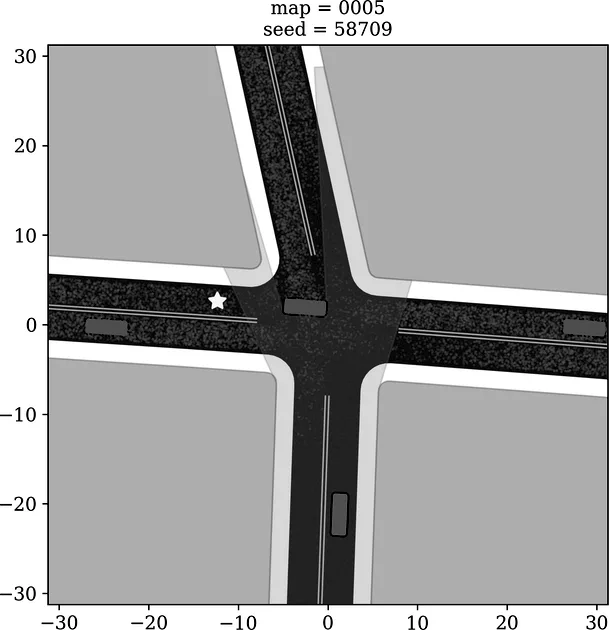
Cars in cities often cannot see everything around them. Buildings and other vehicles block the view, and sensors only reach so far. This work gives an autonomous vehicle a way to estimate how risky those unseen areas are. Using the known road layout, it extracts the lanes that are hidden from view and samples possible vehicles along them. It then combines those samples into a risk estimate. A low-level planner can use the estimate to shape trajectories, and a high-level planner can use it to choose routes. On intersections from real map data with up to five other vehicles, collision rates fell 4.8 times compared with a baseline, and driving comfort improved.
Abstract
Navigating safely in urban environments remains a challenging problem for autonomous vehicles. Occlusion and limited sensor range can pose significant challenges to safely navigate among pedestrians and other vehicles in the environment. Enabling vehicles to quantify the risk posed by unseen regions allows them to anticipate future possibilities, resulting in increased safety and ride comfort. This letter proposes an algorithm that takes advantage of the known road layouts to forecast, quantify, and aggregate risk associated with occlusions and limited sensor range. This allows us to make predictions of risk induced by unobserved vehicles even in heavily occluded urban environments. The risk can then be used either by a low-level planning algorithm to generate better trajectories, or by a high-level one to plan a better route. The proposed algorithm is evaluated on intersection layouts from real-world map data with up to five other vehicles in the scene, and verified to reduce collision rates by $4.8\times$ comparing to a baseline method while improving driving comfort.