Safe Trajectory Synthesis for Autonomous Driving in Unforeseen Environments
Shreyas Kousik · Sean Vaskov · Matthew Johnson-Roberson · Ramanarayan Vasudevan
TL;DR
Planning with a simple model plus a precomputed reachable set of the true vehicle's motion lets runtime obstacle checks guarantee collision-free trajectories.
BRIEF
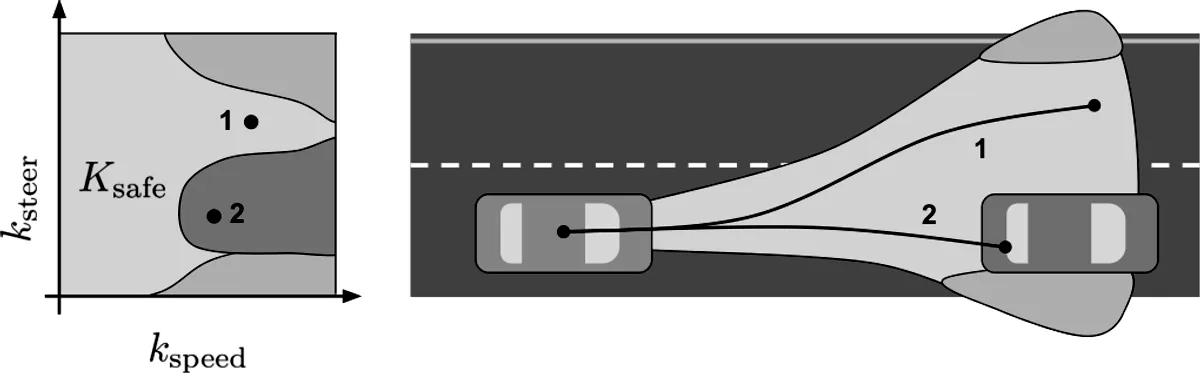
Guaranteeing that a self-driving vehicle will not collide is difficult when it is described by a detailed dynamic model, because checking safety in real time becomes too expensive. This work plans with a simple low-fidelity model and accounts for the mismatch with the true vehicle. Offline, it computes a conservative forward reachable set of the high-fidelity model's motion while tracking simple plans. At runtime, obstacles are intersected with this set to remove unsafe trajectories, and the best remaining one is chosen. Simulations use a Dubin's car and a dynamic unicycle.
Abstract
Path planning for autonomous vehicles in arbitrary environments requires a guarantee of safety, but this can be impractical to ensure in real-time when the vehicle is described with a high-fidelity model. To address this problem, this paper develops a method to perform trajectory design by considering a low-fidelity model that accounts for model mismatch. The presented method begins by computing a conservative Forward Reachable Set (FRS) of a high-fidelity model's trajectories produced when tracking trajectories of a low-fidelity model over a finite time horizon. At runtime, the vehicle intersects this FRS with obstacles in the environment to eliminate trajectories that can lead to a collision, then selects an optimal plan from the remaining safe set. By bounding the time for this set intersection and subsequent path selection, this paper proves a lower bound for the FRS time horizon and sensing horizon to guarantee safety. This method is demonstrated in simulation using a kinematic Dubin's car as the low-fidelity model and a dynamic unicycle as the high-fidelity model.