WaterGAN: Unsupervised Generative Network to Enable Real-time Color Correction of Monocular Underwater Images
Jie Li · Katherine A. Skinner · Ryan M. Eustice · Matthew Johnson-Roberson
TL;DR
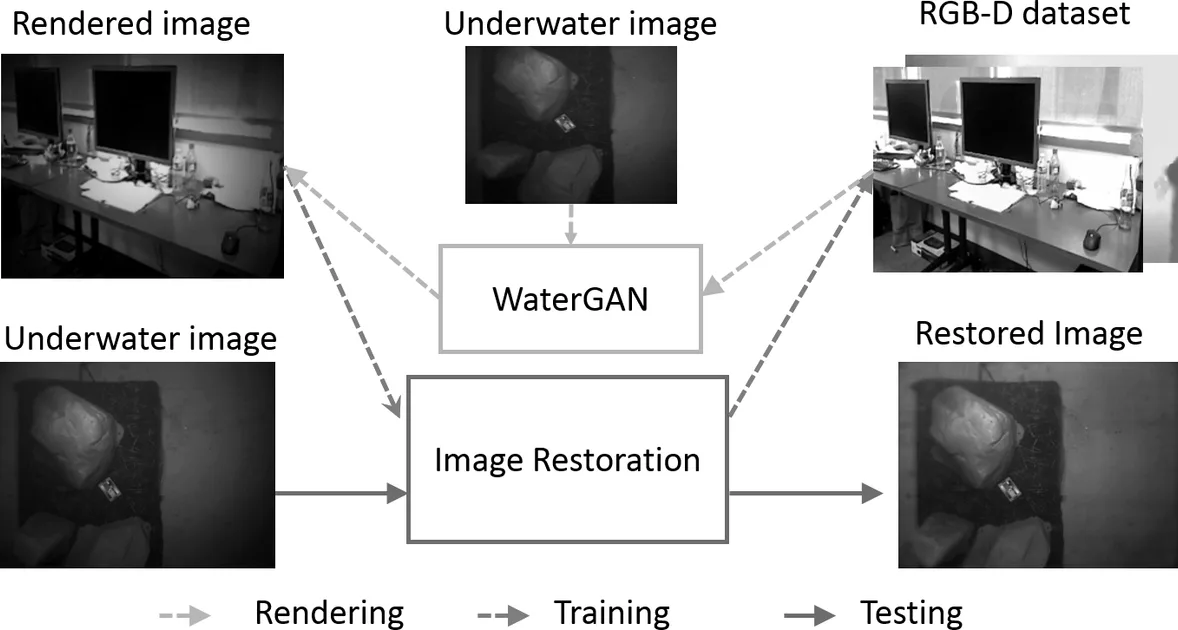
WaterGAN synthesizes realistic underwater images from in-air RGB-D data to train a network that color-corrects single underwater images and estimates coarse depth.
BRIEF
Underwater photos look blue-green and hazy because water absorbs and scatters light differently at each wavelength. Physical models exist, but their parameters are hard to know without field calibration. Deep learning could learn the correction, but it needs paired training images that are scarce in the deep sea. WaterGAN generates realistic underwater images from in-air color and depth data without paired supervision. These synthetic pairs train a network that restores true color from a single underwater image and also learns a coarse depth estimate. Tests used real data from a water tank and field surveys.
Abstract
This paper reports on WaterGAN, a generative adversarial network (GAN) for generating realistic underwater images from in-air image and depth pairings in an unsupervised pipeline used for color correction of monocular underwater images. Cameras onboard autonomous and remotely operated vehicles can capture high resolution images to map the seafloor, however, underwater image formation is subject to the complex process of light propagation through the water column. The raw images retrieved are characteristically different than images taken in air due to effects such as absorption and scattering, which cause attenuation of light at different rates for different wavelengths. While this physical process is well described theoretically, the model depends on many parameters intrinsic to the water column as well as the objects in the scene. These factors make recovery of these parameters difficult without simplifying assumptions or field calibration, hence, restoration of underwater images is a non-trivial problem. Deep learning has demonstrated great success in modeling complex nonlinear systems but requires a large amount of training data, which is difficult to compile in deep sea environments. Using WaterGAN, we generate a large training dataset of paired imagery, both raw underwater and true color in-air, as well as depth data. This data serves as input to a novel end-to-end network for color correction of monocular underwater images. Due to the depth-dependent water column effects inherent to underwater environments, we show that our end-to-end network implicitly learns a coarse depth estimate of the underwater scene from monocular underwater images. Our proposed pipeline is validated with testing on real data collected from both a pure water tank and from underwater surveys in field testing. Source code is made publicly available with sample datasets and pretrained models.